For me codex is a form of LLM that can read and edit my files. Today, with my friend Maksim Mishin we tested it on several of my current work tasks. One particular example resonates with my very first try of an LLM from December 2022: https://doublelayer.eu/vilab/2022/12/01/playing-with-galactica/
Here is where we are after 3.5 years. An agent with skills enabling interaction with my Zotero library allows to answer a questions like why CoPc is so selective towards CO in CO2RR.
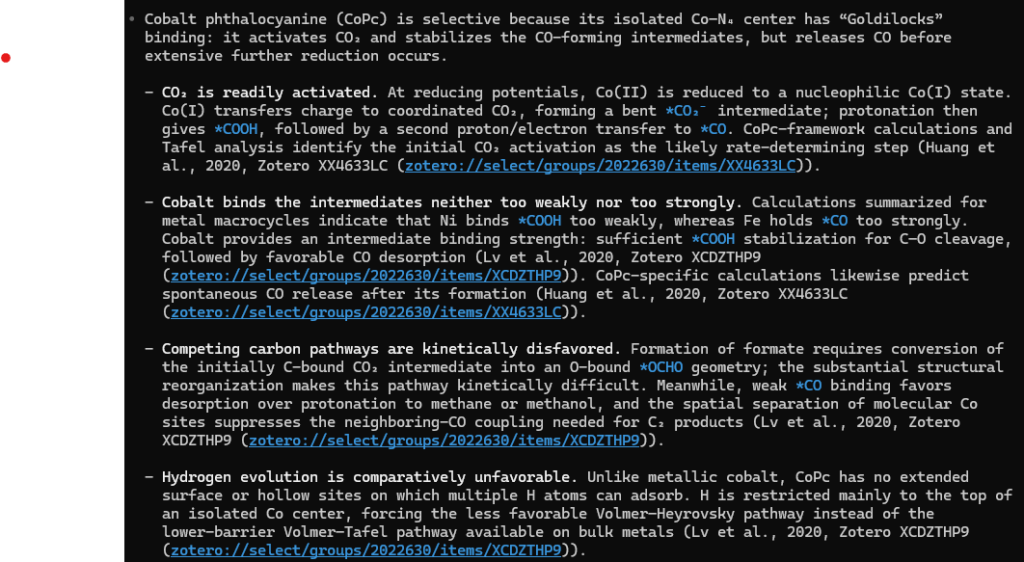
So I have asked ScopusAI, ChatGPT deepsearch, and Google Scholar Labs the same question. Google Scholar Labs are the fastest and rather good, i.e. gives meaningful and diverse explanations. ScopusAI picked a very non-standard explanation and presented it in different ways in its long answer – a highly doubtful result. ChatGPT deepsearch takes too long!!! In 8 minutes it generated a report which is surprisingly deep and correct.
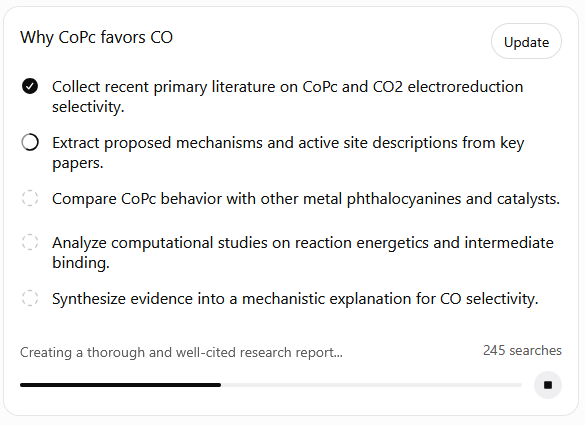

I am repeating the text with ScopusAI, ChatGPT deepsearch, and Google Scholar Labs at least twice a year. ScopusAI consistently gives results that differ from my expert (biassed) knowledge, so I would not trust it and, thus, do not recommend it to my colleagues. Google Scholar Labs is a cool tool to pre-select sources. ChatGPT deepsearch is at least progressing – it is the first time it gives a meaningful overview.
Overall, the experiment with Codex feels different. Here it helps me to summarize already pre-selected sources. And it allows me to check them in one click. Which makes this approach at least promising.
